
AFMESI Founder Dr. Felicia Chinwe Mogo Speaks on Blue Economy and Coastal Resilience at SAN’s 58th Annual Conference (EKO 2026)
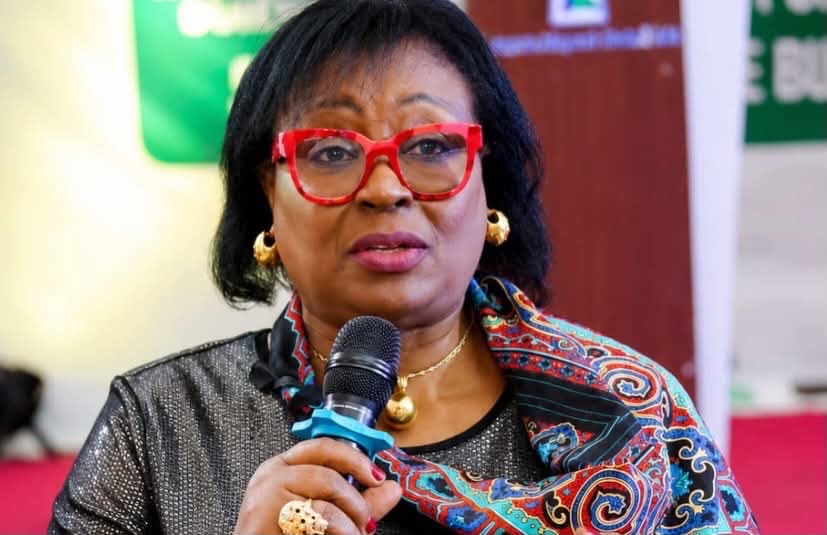
Dr. Felicia Chinwe Mogo addressing delegates and stakeholders during her plenary session at the EKO 2026 conference.
Dr. Felicia Chinwe Mogo, Founder and President of the African Marine Environment Sustainability Initiative (AFMESI), delivered a plenary presentation titled “Blue Economy and Urban Coastal Resilience” at the 58th Annual Conference of the Science Association of Nigeria, tagged EKO 2026. Hosted in partnership with the Lagos State Ministry of the Environment & Water Resources at the Lagos Airport Hotel, Ikeja, the event gathered key leaders, academics, and policymakers under the central theme of science, coastal cities, public health, and social equality within the blue economy.
In her presentation, Dr. Mogo detailed the essential connection between marine resource development and urban coastal protection, emphasizing that a sustainable blue economy depends on climate-resilient coastal infrastructure. Focusing on Lagos, which features a 180 km coastline with over 40% of its land area composed of water bodies and wetlands, she highlighted four pressing challenges: rapid urbanization, climate impacts, public health risks from flooding, and unequal exposure to environmental hazards in vulnerable communities.
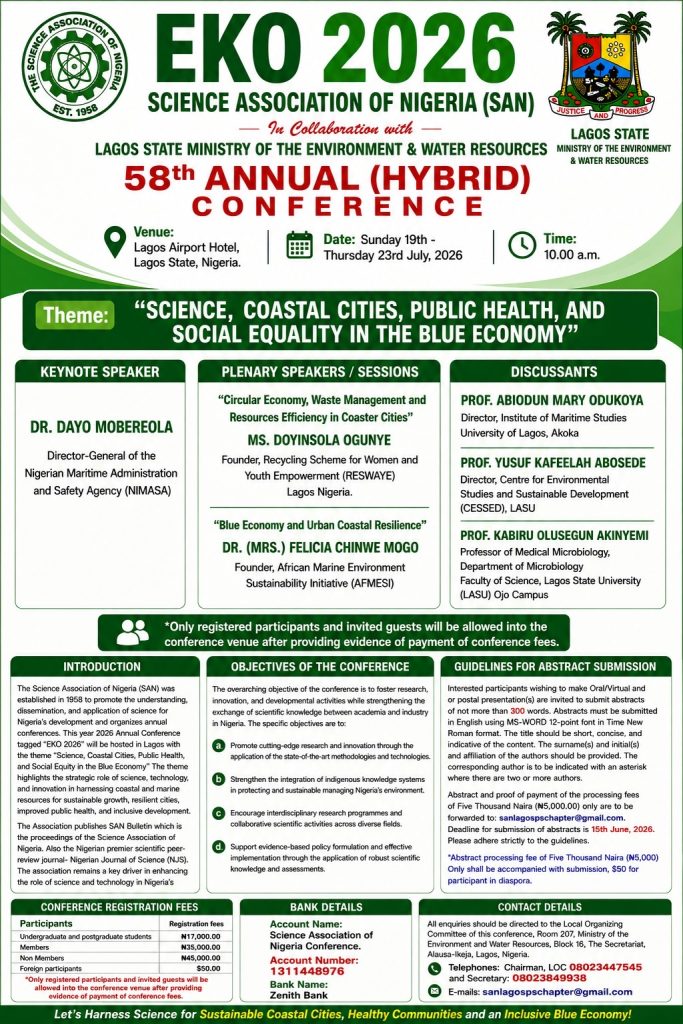
The official event flyer for the Science Association of Nigeria’s 58th Annual Conference, highlighting key sessions and speakers.
Addressing sustainable solutions, Dr. Mogo noted that AFMESI’s efforts in urban coastal resilience are aligned with its primary projects, “Sustainable Ocean Resilience for African Communities” and “Protecting Africa’s Marine Ecosystems,” both formally endorsed as Decade Actions under the UN Decade of Ocean Science for Sustainable Development. Drawing insights from international models in Rotterdam, Singapore, and Seychelles, she recommended strategies tailored for Lagos, including integrated coastal zone management, floating urban structures, nature-based solutions, and marine spatial planning.
Emphasizing social equity, Dr. Mogo underscored that blue economy frameworks must prioritize gender inclusion and community involvement. With women comprising nearly half of the global fisheries workforce, policy planning must safeguard informal workers, artisanal fishers, youth, and coastal residents. She concluded that the future of African coastal cities relies on integrated, science-led action, stressing that coastal zones must be managed as living ecosystems connecting economy, health, and justice rather than simple sites of resource extraction.
