
AFMESI Successfully Hosts Its 5th Annual Symposium 2025!
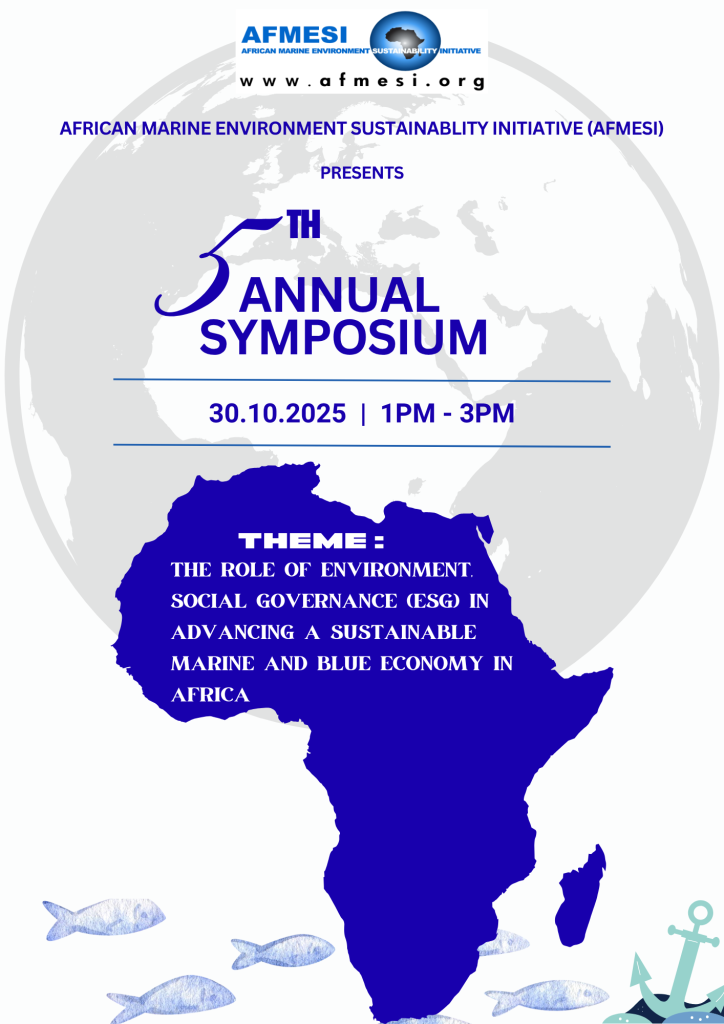
Lagos, Nigeria – October 30, 2025
The African Marine Environment Sustainability Initiative (AFMESI) has once again demonstrated its leadership in driving Africa’s ocean sustainability agenda with the successful hosting of its 5th Annual Symposium — a high-level gathering that brought together policymakers, academia, industry experts, and international organizations to discuss how Environmental, Social, and Governance (ESG) principles can reshape Africa’s Blue Economy.
Themed “The Role of ESG Principles in Advancing a Sustainable Blue Economy in Africa,” the virtual symposium marked a major milestone for AFMESI as it unveiled its IOC-UNESCO-endorsed Ocean Decade Action Project and launched the organization’s flagship publication, “Blue Horizon Magazine.”
A Milestone Gathering for Africa’s Ocean Future
Held virtually, the event attracted notable personalities, including representatives from the Federal Ministry of Marine and Blue Economy, UNESCO-IOC Africa, NIMASA, the African Development Bank (AfDB), Nigerian Chamber of Shipping, and leading maritime institutions across the continent.
In her opening remarks, Dr. (Mrs.) Felicia Chinwe Mogo, Founder and President of AFMESI, welcomed participants and underscored the need to move from policy discussions to actionable strategies. She emphasized that Africa’s Blue Economy can only thrive when ESG principles are embedded into its governance and investment frameworks.
“Our oceans are not just resources to be exploited; they are life-support systems that sustain economies and communities. Integrating ESG into the Blue Economy is the pathway to ensuring equity, resilience, and sustainability for generations to come.”
— Dr. Felicia Chinwe Mogo, AFMESI President
Dr. Mogo — a globally recognized Strategic Expert in Marine/ Blue Economy and Institutional Strategies — is credited with pioneering and introducing the Blue Economy agenda as an emerging area of sustainability for the Federal Government of Nigeria to key into. Under her leadership, AFMESI continues to strengthen science-policy engagement, promote ocean resilience, and champion ESG integration across Africa’s maritime and coastal landscapes.
Special Remarks from the Honourable Minister
Delivering the message of the Honourable Minister of Marine and Blue Economy, His Excellency Mr. Adegboyega Oyetola, CON, the Senior Special Adviser to the President and Senior Technical Adviser to the Minister, Professor Stephen Fakinlede, commended AFMESI for its vision and consistency in promoting ocean sustainability, and also acknowledged Dr. Mogo’s strategic contributions to shaping the Ministry’s sustainability roadmap.
“The Ministry is proud to identify with AFMESI’s mission. The future of Nigeria’s maritime sector depends on how well we integrate science, governance, and community participation in managing our ocean resources.”
— Prof. Stephen Fakinlede, on behalf of the Honourable Minister
Special Opening Remarks by the Chairman
Alhaji Aminu Umar, Chairman, Sea Transport Group and President of the Nigerian Chamber of Shipping (NCS), delivered the special opening remarks as Chairman of the occasion.
He commended AFMESI for creating a credible platform for multi-stakeholder dialogue and policy innovation, emphasizing that ESG must become the guiding compass for Africa’s development path.
“Africa is burdened by pollution, climate change, and over-exploitation. ESG isn’t just best practice — it’s our compass toward sustainable development. The private sector must take responsibility by embedding sustainability into every stage of the maritime value chain.”
— Alhaji Aminu Umar, Chairman of the Occasion
He called for increased collaboration among government agencies, academia, and industry to translate ESG principles into measurable impacts across African coastlines and maritime operations.
Goodwill Messages
Chief Guest of Honor: Prof. Stephen Fakinlede
Senior Special Adviser to the President and Senior Technical Adviser to the Honourable Minister of Marine and Blue Economy
Delivering the message of His Excellency Mr. Adegboyega Oyetola, CON, Honourable Minister of Marine and Blue Economy, Prof. Fakinlede praised AFMESI’s sustained advocacy and technical leadership in promoting marine environmental sustainability.
He announced that the Ministry had approved the establishment of a Sub-Technical Committee, comprising experts from AFMESI, NIMASA, and the Ministry, to ensure that outcomes from the symposium are translated into actionable frameworks for ocean governance and ESG integration.
Special Guest of Honor (International): Dr. Ibukun Adewumi
Head, IOC-UNESCO Sub-Commission for Africa and the Adjacent Island States
Dr. Ibukun Adewumi in his goodwill message emphasized the need for African-led ocean governance and science-based decision-making to effectively address the continent’s unique marine challenges. He highlighted IOC Africa’s efforts in strengthening ocean observation systems, promoting sustainable marine spatial planning, fostering data sharing and capacity building, and supporting ocean science infrastructure. Dr. Adewumi also called for an inclusive and equitable Blue Economy that creates jobs, restores ecosystems, and sustains cultural practices, while urging increased investment in the next generation of African ocean professionals to bridge science and policy for sustainable marine development.
Dr. Abdul B. Kamara
Director General, Nigeria Country Office, African Development Bank (AfDB)
Represented by Dr. Gerald Njume
Dr. Njume conveyed AfDB’s goodwill message on behalf of Dr. Kamara, reaffirming the Bank’s commitment to funding climate-resilient and sustainability-driven blue economy initiatives across Africa.
“The AfDB is proud to stand with AFMESI in its mission to promote inclusive and sustainable ocean development. The Bank recognizes ESG as a key tool for balancing economic growth with environmental stewardship.”
— Dr. Gerald Njume, representing Dr. Abdul B. Kamara
Professor Magnus Onuoha
President, Governing Council, Nigeria’s Renewable Energy and Energy Efficiency Associations Alliance (REEEAA)
Prof. Onuoha emphasized the crucial link between renewable energy adoption and the success of Africa’s Blue Economy. He highlighted that integrating ESG principles with clean energy technologies can transform Africa’s maritime industries and reduce carbon footprints.
“The future of Africa’s ocean economy lies in clean energy transitions and green technology investments.”
— Prof. Magnus Onuoha, REEEAA President
Mrs. Vivian Chimezie-Azubuike
Director-General, Nigerian Chamber of Shipping
Mrs. Azubuike applauded AFMESI for its dedication to marine sustainability and called for gender inclusion, youth empowerment, and capacity building in maritime governance.
“Sustainability must be driven by people and purpose. Women and youth must be part of the change as we build a sustainable Blue Economy for Africa.”
— Mrs. Vivian Chimezie-Azubuike, DG, NCS
Keynote Insights: Mainstreaming ESG for Africa’s Marine Growth
Delivering the keynote address, Professor Lawrence Ezemonye, Vice-Chancellor of Igbinedion University, Okada, and Chairman of the Committee of Vice Chancellors of Nigerian Universities, called on the Federal Government to develop a national ESG Masterplan to guide Nigeria’s transition to a sustainable marine and blue economy.
He proposed the creation of an ESG Fund and a national ESG Audit System to track and assess both government and corporate performance in marine sustainability. He cautioned that “without measurable indicators and dedicated funding mechanisms, ESG will remain rhetoric rather than a transformative tool.”
“We must move beyond policy talk to implementation. An ESG Masterplan, with measurable targets and dedicated funding, is essential to ensure that sustainability drives every decision in Nigeria’s marine and blue economy sectors.”
— Prof. Lawrence Ezemonye, Vice-Chancellor, Igbinedion University
Prof. Ezemonye pledged to take the symposium’s resolutions to the academic community, with a view to embedding ESG principles and Blue Economy studies into Nigerian university curricula nationwide. He further emphasized the need for youth and women inclusion, institutional capacity building, and the use of data, artificial intelligence, and green technology to drive blue innovation across Africa.
Launch of the IOC-UNESCO-Endorsed Project: SORAC
A major highlight of the symposium was the presentation of AFMESI’s IOC-UNESCO-endorsed Decade Action Project, titled “Sustainable Ocean Resilience for African Communities (SORAC).”
Presented by Dr. Ibukun Adewumi, Head of the IOC-UNESCO Sub-Commission for Africa and the Adjacent Island States, the SORAC Project seeks to strengthen ocean governance, promote coastal resilience, and empower local communities through science, policy integration, and indigenous knowledge.
“SORAC is proof that African-led initiatives can shape global ocean sustainability. It will take collective effort and meaningful science that connects to the realities of fishermen, women, and youth in our coastal communities.”
— Dr. Ibukun Adewumi, Head, UNESCO IOCAFRICA
The project, which aligns with the UN Ocean Decade (2021–2030), will focus on:
- Ecosystem restoration and mangrove rehabilitation;
- Community-led climate adaptation initiatives;
- Integration of ESG metrics in national ocean policies; and
- Capacity building for women and youth in coastal regions.
Blue Horizon Magazine: Africa’s Voice for Ocean Sustainability
The symposium also witnessed the launch of AFMESI’s maiden publication — “Blue Horizon Magazine,” presented by Mrs. Nkoli Omhoudu, an award-winning journalist with AIT and member of the AFMESI Think-Tank Team.
The magazine is designed to highlight Africa’s ocean stories, innovations, and sustainability successes, serving as a continental platform for knowledge sharing, research dissemination, and advocacy. Mrs. Omhoudu urged stakeholders to support the publication through partnerships, sponsorships, and content contributions, stressing the importance of keeping the conversation around sustainable ocean management alive.
Five-Year Roadmap for Ocean Resilience
Dr. Felicia Mogo presented AFMESI’s Five-Year Implementation Plan for the SORAC project, outlining strategic interventions that combine ecosystem restoration, policy advocacy, and ESG education.
The plan envisions collaboration with governments, universities, and local communities across Africa to build resilient coastlines, strengthen ocean governance, and promote inclusive, science-based solutions.
She emphasized that ESG adoption must be backed by strong policy frameworks and continuous capacity development to ensure long-term sustainability.
Technical Presentations and Panel Discussions
The technical session featured international experts who presented diverse perspectives on sustainability challenges and opportunities in Africa’s maritime and coastal sectors.
- Community Engagement: The Cornerstone of a Sustainable & Inclusive Blue Economy in Africa
By Abir Yahyaoui, Senior Program Officer – Tunisia, Natural Resource Governance Institute (NRGI)
Abir stressed that community participation and transparency are key to successful Blue Economy governance.
“Community engagement isn’t a formality — it’s the foundation of legitimacy, trust, and shared responsibility.”
— Abir Yahyaoui
- Shipping Pressures and Impacts on the Marine Environment
By Ida-Maja Hassellöv, PhD, Professor of Maritime Environmental Science, Director, Chalmers Ocean, Chalmers University of Technology, Sweden
Prof. Hassellöv analyzed the environmental impact of shipping, highlighting pollutants beyond carbon emissions — including microplastics, pathogens, and pharmaceuticals.
“We must innovate to make maritime transport truly sustainable.”
— Prof. Ida-Maja Hassellöv
- Why Africa Needs ESG
By Dr. Mohammed Hamadina, Environmental and Social Safeguards Consultant, African Development Bank Group (AfDB)
Dr. Hamadina emphasized that ESG frameworks attract responsible investments and strengthen governance.
“ESG is Africa’s gateway to sustainable financing, regulatory credibility, and global competitiveness.”
— Dr. Mohammed Hamadina
A Call to Action: Building Africa’s Sustainable Ocean Future
In her closing remarks, Ms. Rabia Yahia Meddah, AFMESI Think-Tank-Team Member, thanked all dignitaries and participants for their commitment. She reaffirmed AFMESI’s dedication to transforming symposium outcomes into measurable action, stating:
“The ocean connects us all. Its health determines our shared prosperity. Let our discussions today ripple across Africa’s shores — turning ideas into impact and securing our ocean legacy for future generations.”
— Ms. Rabia Yahia Meddah, AFMESI Think-Tank Member
She also expressed gratitude to AFMESI’s partners — including the Federal Ministry of Marine and Blue Economy, UNESCO-IOC, and NIMASA — for their ongoing collaboration in advancing ocean sustainability initiatives.
Looking Ahead
The symposium concluded with strong commitments from the Ministry, academia, and industry stakeholders to continue collaborating with AFMESI. Among the key resolutions were:
- Formation of a Sub-Technical Committee involving AFMESI, NIMASA, and the Ministry to implement symposium outcomes;
- Establishment of a technical working group on ESG integration and ocean governance;
- Mobilization of resources and partnerships for Blue Horizon and SORAC projects;
- Conduct of environmental and social vulnerability assessments for coastal communities;
- Integration of ESG and Blue Economy studies into Nigerian university curricula.
With the unveiling of SORAC and the launch of Blue Horizon Magazine, AFMESI reaffirmed its position as a catalyst for sustainable transformation across Africa’s marine and coastal ecosystems.
🌐 For More Information or Partnership Enquiries:
📧 Email: contact@afmesi.org
🌍 Website: https://www.afmesi.org
Full Video: https://www.youtube.com/watch?v=gPsix1K4Pe4
